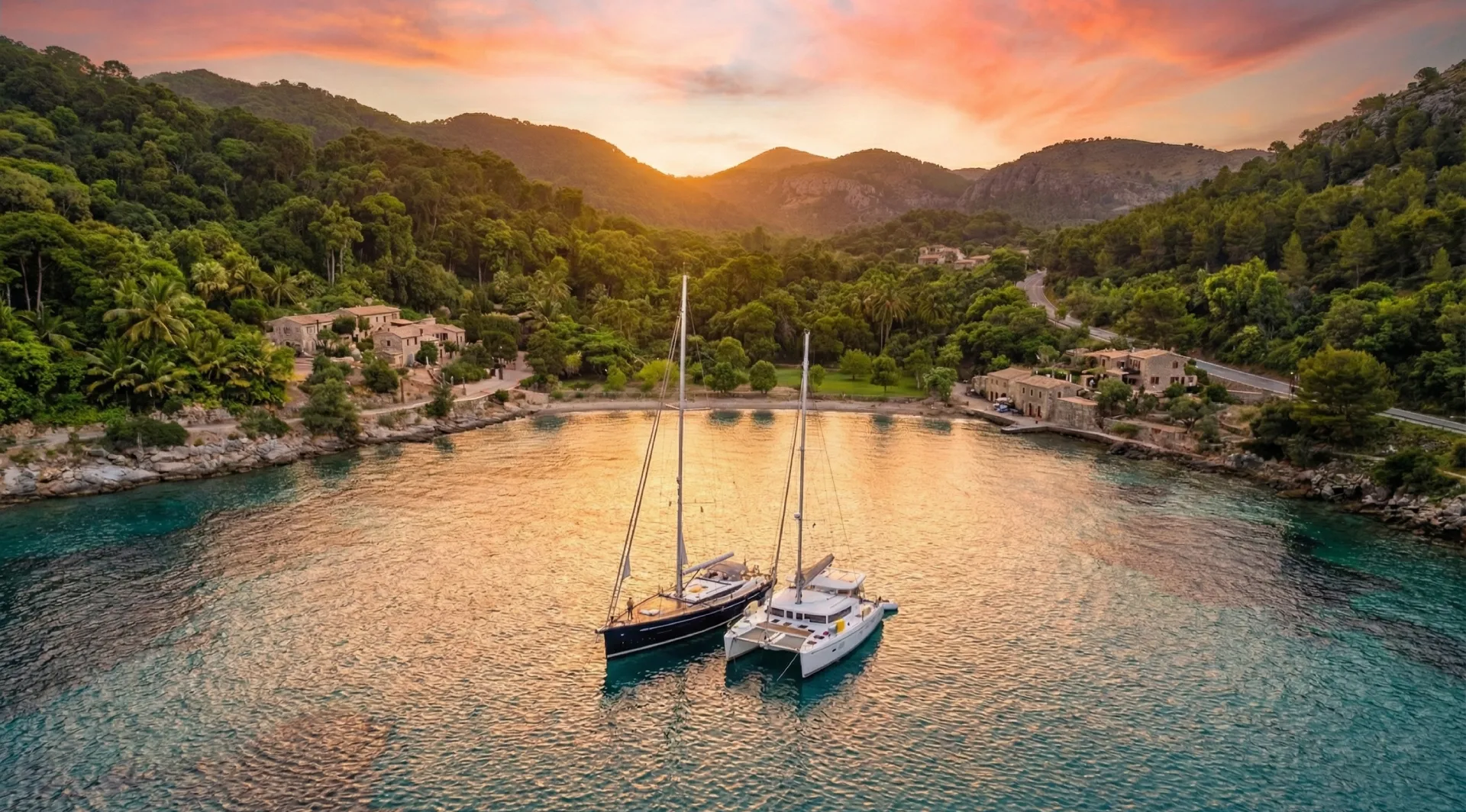
Sailing in Spain: routes, winds and practicalities
Spain offers an unusually broad canvas for sailors: Atlantic rías, Mediterranean calas and year-round trade-wind passages in the Canaries. Distances can be dialled up or down, the marina network is extensive, and weather patterns are well-documented. This guide sets out where to sail, when to go and how to plan a safe, rewarding cruise - whether you're plotting a Balearic island-hop, a culture-rich Costa Brava meander or a winter sun escape to Lanzarote.
Choosing a start harbour? See the Valencia charter bases guide for Saturday logistics and which marina fits your week.
Quick links
- Sailing in Spain: routes, winds and practicalities
- Why Sail in Spain?
- Sample Itineraries
- When to Go
- Wind and Weather
- Getting There
- Chartering in Spain
- Licences and Formalities
- Anchorages and Marinas
- FAQs
- References
Why Sail in Spain?
Few countries compress so much sailing variety into one coastline. On the Mediterranean side you'll find calas with turquoise water, steep-sided coves that take lines ashore, and a dependable regime of sea breezes framed by occasional tramontana and levante episodes. On the Atlantic, Galicia's rías behave like fjords with river scenery, sheltered anchorages and rewarding pilotage. In the Canary Islands, the NE trades make for confident, mile-building passages with warm temperatures year-round.
Spain also excels at shoreside experience. Historic ports - Barcelona, Palma, Cádiz, A Coruña - sit alongside low-key fishing marinas and national-park anchorages. Provisioning is straightforward, repair facilities are widely available, and transport links into and out of bases are strong. You can cruise quietly between villages or step into lively waterfronts within the same week.
For charter crews, the country is well served by professional fleets. Documentation is clear, VHF and safety standards are enforced, and local agencies manage sensitive environments such as Posidonia seagrass and Cabrera National Park with practical, bookable moorings.
Sample Itineraries
Below are three tried-and-tested routes that showcase Spain's breadth: a sheltered Balearic week with a national-park stop, a scenic Costa Brava loop shaped by the tramuntana, and an Atlantic rías sampler with tides, mussel rafts and island reserves. Adjust daily runs to suit weather, crew energy and daylight, and always confirm local restrictions before you go.
Mallorca South & Cabrera (7 days, easy-moderate)
This south-coast circuit from Palma threads sandy anchorages, full-service marinas and the protected waters of Cabrera National Park. It keeps to the lee of Mallorca for shorter hops, reliable shelter and easy provisioning, with options to linger in clear-water calas if conditions are settled.
Day 1 - Palma to Colònia de Sant Jordi (18-22 nm)
Slip Palma early to ride the building embat east. Clear the bay, give Cabo Blanco a sensible offing, and aim for Colònia de Sant Jordi. Anchor off the long beaches in sand (4-6 m) or take a visitor berth; it's an easy first-night reset with simple pilotage and good swimming in calm weather.
Day 2 - Colònia de Sant Jordi to Cabrera National Park (12-15 nm)
Make a short hop to Cabrera and pick up a pre-booked mooring - anchoring is restricted. Arrive mid-afternoon to secure a relaxed evening: hike to the castle for sunset, stargaze in the dark-sky bay and respect park rules (no discharges, no night movements). Water is crystal clear; snorkelling is excellent.
Day 3 - Cabrera to Cala d'Or (22-24 nm)
Reach up Mallorca's SE corner. The Cala d'Or lagoon network is well sheltered with a full-service marina, easy provisioning and dining on the quay. In an easterly swell, consider Porto Petro as a calmer alternative a mile north.
Day 4 - Cala d'Or to Portocolom (8 nm)
Keep it relaxed. Pause for lunch at Cala Mondragó if swell is low and drop on sand clear of Posidonia. Portocolom's spacious, historic harbour offers reliable shelter, fuel and a pleasant evening stroll among pastel facades.
Day 5 - Portocolom to Sa Ràpita / Es Trenc (24-28 nm)
Coast-hop west, favouring sand patches along Es Trenc for a swim stop in settled weather. Overnight on a berth at Club Nàutic Sa Ràpita, or anchor with care if the forecast remains light and offshore; holding is generally good in sand.
Day 6 - Sa Ràpita to Palma (24-28 nm)
Work back along the south coast with the afternoon sea breeze on the beam. If conditions are kind, detour into Cala Pi for lunch. Consider topping up fuel today to avoid Friday queues at Palma's fuel dock.
Day 7 - Palma lay day or short hop
Build in contingency for refuelling and hand-back. Explore Palma's old town and La Seu cathedral, or take a brief sail across the bay to Portals Vells for a final swim in limestone caves before check-out.
Costa Brava Loop from L'Estartit (7 days, moderate)
A 7-day route. Adjust legs to forecast, moorings and crew preferences.
A compact circuit shaped by headlands and coves, this route highlights the drama of Cap de Creus. Choose windows between tramuntana episodes, mix marina nights with sandy calas, and plan short legs to explore ashore in whitewashed towns.
Day 1 - L'Estartit to Cala Montgó / L'Escala (6-8 nm)
Shake down in the lee of Montgrí. Anchor in Cala Montgó on sand with excellent protection from westerlies, or continue to L'Escala for a snug berth if a northerly builds. A short day keeps the crew fresh.
Day 2 - L'Escala to Roses (12-15 nm)
Round the Empúries shore to Roses. The bay is broad with several marina choices, solid provisioning and repair options. Use the stop to position for Cap de Creus and review tramuntana timing.
Day 3 - Roses to Cadaqués (10-12 nm)
Time your departure for a lull in the tramuntana. In settled conditions, explore the calas east of Cap Norfeu before entering Cadaqués. Expect visitors' buoys in season; the whitewashed waterfront and galleries reward a night or two.
Day 4 - Cadaqués to El Port de la Selva (8-10 nm)
Hop via the Cap de Creus coves, watching for katabatic gusts. El Port de la Selva is well protected, with a practical marina and good shelter if a northerly surges through.
Day 5 - El Port de la Selva to Aiguablava (22-28 nm)
Reach back south along a crenellated coast. In calm weather, set the hook on sand in Aiguablava or neighbouring Sa Tuna, often using a long line ashore. Water clarity is superb for a late swim.
Day 6 - Aiguablava to Palamós (10-14 nm)
Coast the headlands with lunch options in pocket coves. Palamós offers all services, a compelling maritime museum and excellent seafood within walking distance of the pontoons.
Day 7 - Palamós to L'Estartit (16-20 nm)
Pause at the Medes Islands reserve for a lunchtime swim and snorkel - observe access restrictions and buoy rules - then ride the afternoon breeze back to base.
Galicia's Rías Baixas from Baiona (7 days, moderate)
A 7-day route. Adjust legs to forecast, moorings and crew preferences.
Atlantic Spain rewards patient pilotage and tide-aware planning. This week samples island reserves, lively urban marinas and tranquil ría anchorages, with short legs that leave time for hiking dunes and sampling seafood.
Day 1 - Baiona to Islas Cíes (10-12 nm)
Clear the breakwater and set course for the Cíes. Book anchoring permissions in advance and arrive early to pick sand patches with swell lee. Come ashore to hike the dunes and enjoy wide Atlantic sunsets.
Day 2 - Cíes to Vigo (10-14 nm)
Enter the Ría de Vigo with the flood for a fair push. Vigo's central marinas are lively and convenient for provisioning, chandleries and evening tapas along the waterfront.
Day 3 - Vigo to Combarro, Ría de Pontevedra (16-20 nm)
Weave fine pilotage among mussel rafts (bateas), giving them a wide berth. In Combarro, moor stern-to in the compact marina and wander the waterfront lined with traditional hórreos.
Day 4 - Combarro to Sanxenxo (6-8 nm)
A short sail positions you in a full-service hub. Use the day for laundry, fuel and a supermarket stock-up, or walk the beaches if the weather is fair.
Day 5 - Sanxenxo to Illa de Arousa (18-22 nm)
Continue north into the broad Ría de Arousa. Anchor on sand south of Illa de Arousa for a quiet night, or head to Vilagarcía if you prefer a marina with all amenities.
Day 6 - Illa de Arousa to Isla de Ons (16-20 nm)
Return south with the tide to the Ons archipelago. Overnight stays require permits; the setting is wild and beautiful with excellent walking paths and beaches.
Day 7 - Isla de Ons to Baiona (22-26 nm)
Exit the Ría de Pontevedra and lay a course for Baiona. Outside the islands expect Atlantic swell on the beam; inside the bay you'll find calmer water and a warm welcome back at the club.
When to Go
- Mediterranean coasts and Balearics: May to October is prime. Expect settled highs with reliable afternoon sea breezes (the embat) and very little rain. July-August bring heat, crowds and highest marina tariffs; May-June and September-October are calmer and better value.
- Costa Brava and Catalonia: Similar window, but the tramuntana (strong N-NW) can blow hard, particularly spring and winter. Summer usually sees shorter tramuntana episodes separated by benign days.
- Atlantic Spain (Galicia, Bay of Biscay): Best June to September. You'll meet more low-cloud, fog patches and Atlantic swell, but the rías offer shelter. Spring and autumn can be superb with care for passing fronts.
- Canary Islands: All year. NE trade winds dominate; winter (October-April) is ideal for sunshine sailing with fewer calimas and more moderate temperatures than mid-summer.
Water temperatures range from around 16-22 °C on the Atlantic coast in summer to 22-27 °C across much of the Mediterranean and Canaries. Peak Spanish holidays fall in August and around Easter; booking marinas and park permits in advance helps avoid last-minute changes.
Wind and Weather
Spain's sailing weather splits into three broad regimes.
Mediterranean (Catalonia to Andalusia, including the Balearics): Summer is driven by thermals - late-morning onshore breezes freshen to 10-18 knots, easing at dusk. Synoptic events punctuate this pattern. Notable winds include the tramuntana (NW out of the Gulf of Lion, strongest near Cap de Creus and often Menorca), the mistral's reach into the Balearics, and the levante (E) and poniente (W) that pulse along the Alboran Sea and through the Strait of Gibraltar. Expect sharp chop against current in the Strait on a strong levante. Swell wraps into open calas after prolonged easterlies; Posidonia meadows can bring poor holding if you drop in weed.
Atlantic coasts (Galicia, Asturias, Cantabria, Basque Country): Fronts and ridges govern conditions. Summer often brings NW sea breezes and morning calms, with fog banks forming where cool upwelled water meets warm air. Tides are significant (2-4 m in the Rías Baixas) and help or hinder progress at headlands; plan for overfalls in wind-against-tide. Atlantic swell persists after fronts - inside the rías you'll usually find flat water.
Canary Islands: The NE trades blow most days, funnelling between islands to produce acceleration zones that can double the gradient wind. Gusts over 30 knots are common in the gaps and on the south-eastern flanks of high islands. The wind shadow to leeward can be equally stark - expect marked changes in a few miles. Swell is generally from the N-NW; west coasts can be rolly with surf landings.
Forecasts and data: Use national coastal bulletins and buoy networks for a reliable overview, then layer in local marina notices and your observations afloat. In the Canaries, build extra margin for acceleration zones that regularly exceed model guidance.
Getting There
Access is straightforward with multiple international airports near popular bases and frequent ferry services linking islands and mainland hubs.
| Area | Nearest Airports | Ferries and Notes |
|---|---|---|
| Balearic Islands | Palma de Mallorca (PMI), Ibiza (IBZ), Menorca (MAH) | Regular ferries from Barcelona, Valencia and Dénia; strong charter infrastructure in Palma and Ibiza. |
| Catalonia & Valencia | Barcelona (BCN), Girona (GRO), Valencia (VLC) | Good road and rail links to Costa Brava and Costa del Azahar marinas. |
| South & Strait Area | Málaga (AGP), Jerez (XRY), Seville (SVQ) | Access to Costa del Sol and Costa de la Luz; plan Strait transits around tide and wind. |
| Atlantic Galicia | Vigo (VGO), Santiago de Compostela (SCQ), A Coruña (LCG) | Short transfers to ría marinas; consider onward rail for crew swaps. |
| Canary Islands | Gran Canaria (LPA), Tenerife South/North (TFS/TFN), Lanzarote (ACE) | Inter-island ferries connect the archipelago; services from Huelva/Cádiz to the Canaries operate year-round. |
Spain's high-speed rail network also links Barcelona, Valencia, Alicante, Málaga and Madrid, which helps with one-way deliveries or mid-cruise crew changes.
Chartering in Spain
Fleets and booking
Spain hosts large, established fleets across Palma de Mallorca, Ibiza, Barcelona, Valencia/Dénia, Alicante, Cartagena and the Canary Islands (especially Lanzarote, Gran Canaria and Tenerife). You'll find monohulls and catamarans from 32-55 ft, with options for bareboat, skippered or fully crewed. Peak demand falls in July-August in the Med and around Christmas-February in the Canaries; shoulder seasons book early with experienced crews seeking easier berths and cooler days.
Onboarding and hand-back
Boarding is usually Saturday afternoon with return to base Friday evening for check-out. Damage deposits, outboard/linen packages and cleaning fees are standard. Expect stern-to berthing with lazy lines in marinas; prepare fenders and stern lines before the reception quay. Many bases offer provisioning delivery and route briefings tailored to current restrictions (for example Cabrera mooring allocations and Posidonia protection zones). Plan to refuel early on turnaround day to avoid queues.
Qualifications
For bareboat, most operators accept the ICC (Sail) or RYA Day Skipper Practical, plus a VHF/SRC licence for the skipper. Demanding areas - such as the Canaries, longer offshore passages or larger yachts - may require RYA Coastal Skipper/ICC Coastal equivalence. If you prefer not to skipper, book a local professional; skippers are widely available and add strong local knowledge.
Licences and Formalities
Skipper certification: Spain expects the person in charge to hold proof of competence appropriate to boat length and operating area. For visiting skippers, an ICC (Sail) or RYA Day Skipper Practical is commonly accepted by charter companies for coastal cruising up to around 12 m. Many operators also require the skipper's VHF Short Range Certificate (SRC). For more ambitious itineraries or larger vessels, RYA Coastal Skipper/ICC with coastal endorsement is prudent. Spanish residents use national licences such as PER; visitors do not need a Spanish licence if they hold a recognised equivalent.
Entry and paperwork: Spain is in the Schengen Area. Yachts arriving from outside Schengen should clear at a designated port of entry and keep ship's papers (registration, insurance) and crew passports to hand. On Spanish-flagged charters, the base will file the crew list. Keep original licences aboard.
Environmental rules: Anchoring on Posidonia seagrass is restricted in the Balearics with active patrols; use sand patches and consult official maps before dropping the hook. Cabrera National Park and the Atlantic Island parks (Cíes/Ons) require advance reservations for moorings/anchoring. Some coves impose seasonal buoy fields.
Local conduct: Observe speed limits near beaches and within harbours. Fishing from a boat requires a licence. Drones and spearfishing face specific prohibitions in protected areas - check local notices. Maintain good VHF practice; Spanish and English are used on Ch 16/9, with marina working channels posted on approach.
Before departure, assemble a simple document pack: passports, vessel registration and insurance, skipper qualifications, VHF/SRC, park permits and any anchoring authorisations. Keeping printed copies as well as digital backups streamlines harbour formalities.

Anchorages and Marinas
- Balearics: Deep, well-equipped marinas in Palma, Mahón, Ibiza and Santa Eulària anchor the network, with many public PortsIB facilities in smaller towns. In summer, book early - August tariffs are high. Calas on the east/south coasts of Mallorca and around Ibiza/Formentera offer sand patches with clear water; avoid Posidonia. Cabrera is moorings-only with colour zones by boat length.
- Costa Brava & Catalonia: Visitor berths (amarres de tránsito) are widely available but can be wind-affected in a tramuntana. Many calas are steep-to; long lines ashore help in small pockets like Sa Tuna or Aiguablava. Roses, Cadaqués and El Port de la Selva give reliable shelter for Cap de Creus.
- Valencia to Costa del Sol: Frequent, modern marinas at Dénia, Valencia, Alicante, Cartagena, Almerimar, Málaga and Sotogrande. The Alboran coast feels more open; swell can roll into roadsteads after an easterly (levante). The Strait area has strong currents - await slack for comfortable entries.
- Atlantic Spain (Rías Baixas): Superb, all-weather anchorages inside the rías with mud/sand holding. Marinas at Baiona, Vigo, Combarro, Sanxenxo and Vilagarcía provide full services. Outside the rías, swell and surf limit options.
- Canary Islands: Large bases at Arrecife, Marina Rubicón, Las Palmas, Santa Cruz de Tenerife and San Sebastián de La Gomera. Expect gusty approaches near capes and acceleration zones; check berth availability before long inter-island hops. Many anchorages are open-roadstead and can be rolly in NW swell.
Fuel, water and gas are readily available at major ports, and card payment is the norm. Stern-to with lazy lines is standard in the Med, while Atlantic rías more often use alongside pontoons. Booking portals (such as PortsIB in the Balearics) simplify summer planning; elsewhere, calling ahead on VHF or phone is usually sufficient.
FAQs
.faq-accordion details{border:1px #cccccc solid;border-radius:4px;margin:8px 0;}.faq-accordion summary{padding:10px 15px;cursor:pointer;display:flex;align-items:center;gap:8px;list-style:none;}.faq-accordion summary::-webkit-details-marker{display:none;}.faq-accordion summary::before{content:'▸';color:#12305c;font-weight:700;display:inline-block;transform:rotate(0deg);transition:transform .2s ease;}.faq-accordion details[open] summary::before{transform:rotate(90deg);}.faq-accordion p{padding:10px 15px;margin:0;}
When is the best time to sail in Spain?
For the Mediterranean and Balearics, May-June and September-October combine reliable sea breezes with fewer crowds. Galicia is best June-September. The Canary Islands are a year-round destination, with October-April offering warm, windy but manageable trade-wind sailing.
Do I need a licence to charter in Spain?
Yes. Most companies accept an ICC (Sail) or RYA Day Skipper Practical as a minimum, plus a VHF/SRC for the skipper. For bigger yachts or trickier areas (e.g., the Canaries), RYA Coastal Skipper or equivalent experience may be requested.
Are there tides to consider?
The Mediterranean coast is micro-tidal, but the Atlantic side - especially Galicia and the Bay of Biscay - has significant tides and streams. The Strait of Gibraltar can run at several knots; time passages for slack or a fair push.
Can I anchor anywhere?
No. In the Balearics you must avoid Posidonia seagrass; use the official map and target sand patches. Cabrera National Park and the Cíes/Ons islands require advance permits or allocated moorings. Seasonal swim zones and buoy fields limit proximity to beaches.
How busy do marinas get in summer?
Very. August in the Balearics and Catalonia sells out weeks in advance, with peak pricing. Booking ahead and favouring shoulder months improves availability and costs.
Is Spain suitable for families and new skippers?
Yes - choose sheltered routes. The south and east of Mallorca, Ibiza's leeward side, and Galicia's rías offer short hops and protected waters. The Canaries are best for confident crews comfortable with strong, gusty winds.
Where can I get reliable marine weather?
Use AEMET's coastal and high-seas bulletins, Puertos del Estado buoy data, and local marina notices. In the Canaries, allow for acceleration zones that exceed the forecast gradient wind.
What about fuel and water?
Available at most marinas and many fishing ports. In high season, refuel early in the day to avoid queues, and carry adapters for Med fuel nozzles.
References
- https://www.cruiserswiki.org/wiki/Spain
- https://www.aemet.es/en/eltiempo/prediccion/maritima
- https://www.puertos.es/en-us
- https://www.portsib.es/
- https://posidonia.caib.es/
- https://www.reservasparquesnacionales.es/
- https://www.pbo.co.uk/seamanship/how-to-sail-the-canary-islands-acceleration-zones-71319
- https://www.metoffice.gov.uk/weather/specialist-forecasts/coast-and-sea/shipping-forecast/sea-areas
- https://www.rya.org.uk/knowledge/abroad/icc
- https://www.balearia.com/en
- https://www.navieraarmas.com/en
- https://www.cruiserswiki.org/wiki/Strait_of_Gibraltar
Charter a Yacht
Compare crewed & bareboat charters, learn the best months to sail, and get a custom shortlist from 500+ providers.